
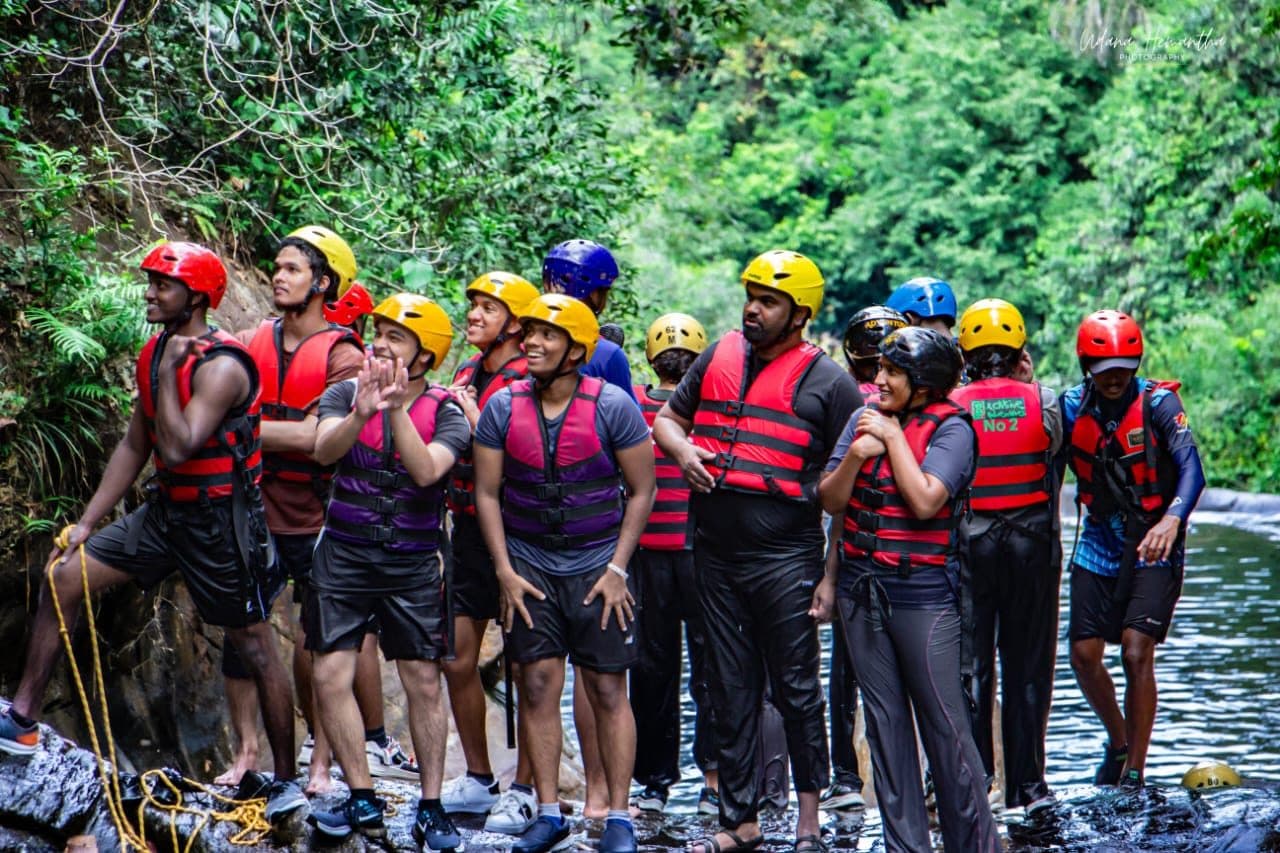
School trips · Safety & supervision
The safety position you can hand to your principal.
Our full policy for school groups at Kitulgala — minimum ages, non-swimmers, supervision ratios, headcounts, approval paperwork. Written to hand straight to whoever signs off your trip.
Groups of up to 100 people · Kitulgala, two hours from Colombo · quote within one working day
Hand this page to whoever signs off your trip — a principal, a deputy head, a parent body, an approval committee. It sets out exactly where we stand. Minimum ages. How we supervise students in the water and on the ground. What we need from you in advance. What we will not put our name to.
We would rather a school read this and decide the trip is wrong for their year group. That is better than a difficult conversation on the riverbank, because an age policy was assumed instead of checked. Everything below is the actual policy we run to — not a marketing version of it.
- Minimum age for river rafting
- 14+
- Students in a single day
- Up to 100
- No overnight to approve
- Day return
- One named guide, all day
- Fixed pods
Minimum ages
Rafting is 14+. No exceptions.
Rafting is 14+. No exceptions. That is the Sri Lanka Tourism Development Authority standard, for every section of the river. We treat it as a rule, not a suggestion.
The market around us is not consistent on this. Some operators here advertise rafting from age six. We do not. Not for a student a few weeks off turning 14. Not for a signed parental consent form. Not because it would be easier to say yes.
If that costs us a booking because part of your group falls under the age line, we lose it. Every time, we build the younger students a genuinely good day instead — rainforest trekking, birdwatching, zip lining, supervised shallow water, team challenges at base. We do not stretch a river rule to keep everyone in one programme.
Other activities
No age law. Kit decides.
Unlike rafting, there is no single published age figure for canyoning, waterfall abseiling or zip lining in Sri Lanka. That does not mean these activities are unregulated in practice. The limiting factor is equipment specification and site conditions, not a law. Both vary by route and by the harness sizes we have on hand for your group.
So we confirm the actual age and size limits against the actual route and equipment your group will use. In writing, when we quote your trip. We do not leave that conversation for the morning of the visit, when thirty students are already standing at the top of a route. If your year group spans an age range that needs checking, tell us the ages when you enquire. We confirm it before you commit to a date.
Age bands
What each age can do at Kitulgala
This is the working version of our age policy. Use it to sanity-check a trip before you write it up for approval.
| Age band | What's included | Not available at this age | Best suited to |
|---|---|---|---|
| 8-12 | Rainforest trekking and birdwatching, zip lining, supervised shallow-water and pool sessions, team challenges and problem-solving at base. | Grade 2-3 river rafting — the SLTDA minimum age is 14, with no exceptions. Full waterfall abseil descents. | Primary and lower-middle year trips, nature or environment clubs, younger scout and guide troops. |
| 13-15 | Everything above, plus canyoning and the natural rock slides, and river rafting once a student has actually turned 14. | Rafting for any student still 13 on the day, regardless of the rest of the year group. Higher abseil pitches where harness sizing does not fit. | Middle and lower-secondary year groups, house or form trips, sports squad days. |
| 16-19 | The full programme: river rafting, canyoning, waterfall abseiling, zip lining, rainforest trekking, and extended multi-activity days. | Nothing on age grounds — individual activities still depend on conditions, confidence and equipment fit on the day. | A/L year groups, prefect and leadership camps, International Award journeys, university and campus batches. |
Mixed-age year groups are normal. We run parallel tracks, not one programme for everyone. A Grade 8 and a Grade 12 student on the same trip both get a full day. The whole group still eats and travels together.
Non-swimmers
Not turned away. Planned for.
A non-swimmer is not automatically excluded from a river-based activity. They are also never quietly put in the water and hoped for. Every participant wears a buoyancy aid. Every raft is guided. The pre-activity briefing covers exactly what to do if you end up in the water — as its own section, not an aside.
Confidence matters as much as swimming ability. A student who can technically swim but is genuinely frightened of open water has just as bad a day as a true non-swimmer. So we ask about both, when you send us your numbers. There is a genuinely good dry-land option at every activity block. No student is talked into the water because a schedule needs them to be.
- Buoyancy aids and helmets for every participant, non-swimmer or not.
- The safety briefing covers exactly what to do in the water, as a distinct section.
- A real dry-land alternative exists at every activity block, not a token one.
- Nobody is pressured or talked into entering the water.
Supervision
Every student gets a number
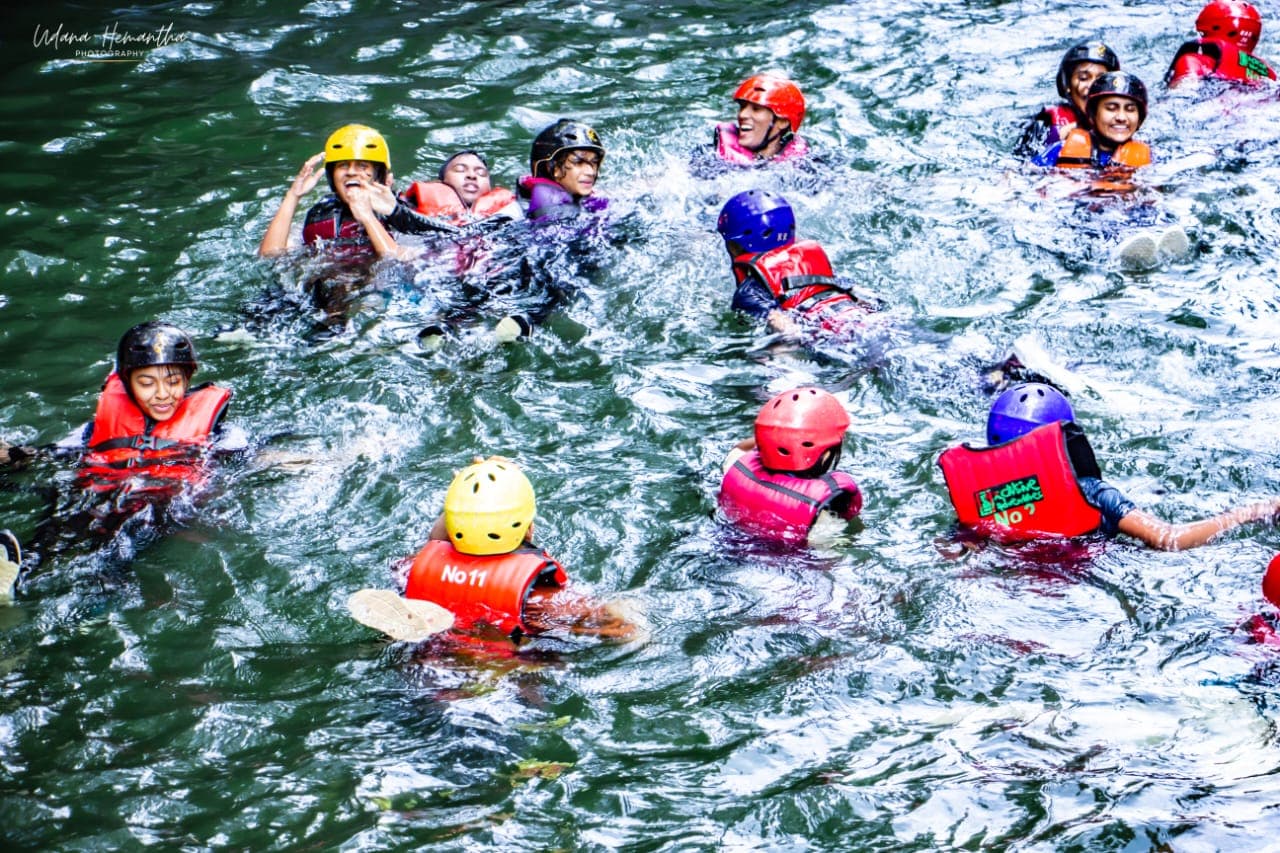
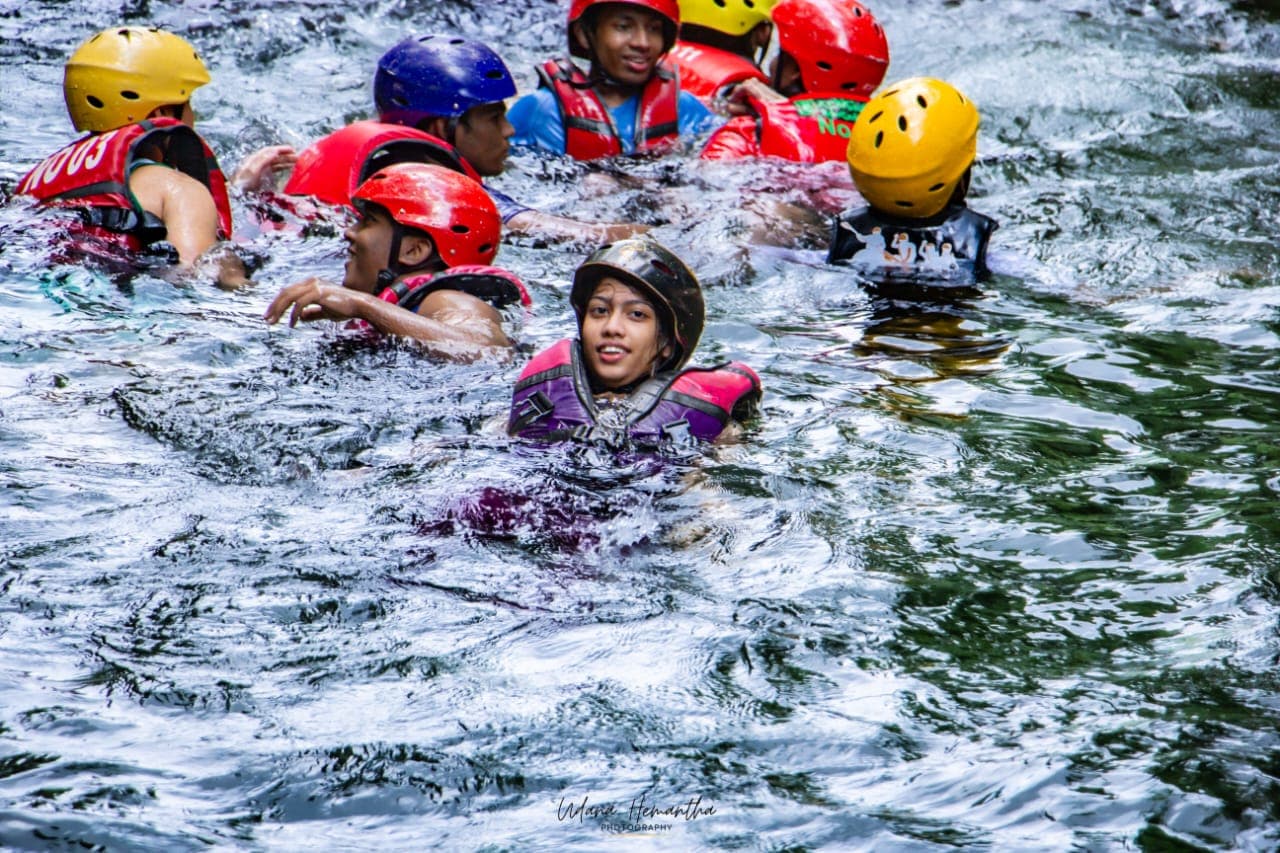
Look at the helmets in our photographs. You will see numbers on them. That is not decoration. Every student gets a number at kit-up. It stays theirs all day. A headcount becomes a fast, specific roll call against a list — not a guess at a moving group of thirty in matching gear.
Students move in fixed pods for the day. Each pod has a named guide who does not change. Pods are not reshuffled between activities. The same adult who did the headcount after breakfast does the count before the bus home.
- Numbered helmets assigned at kit-up, held for the whole day.
- Fixed student pods with one named guide — not rotating groups.
- The same guide, and the same pod, from kit-up to departure.
Headcounts
When we count, out loud
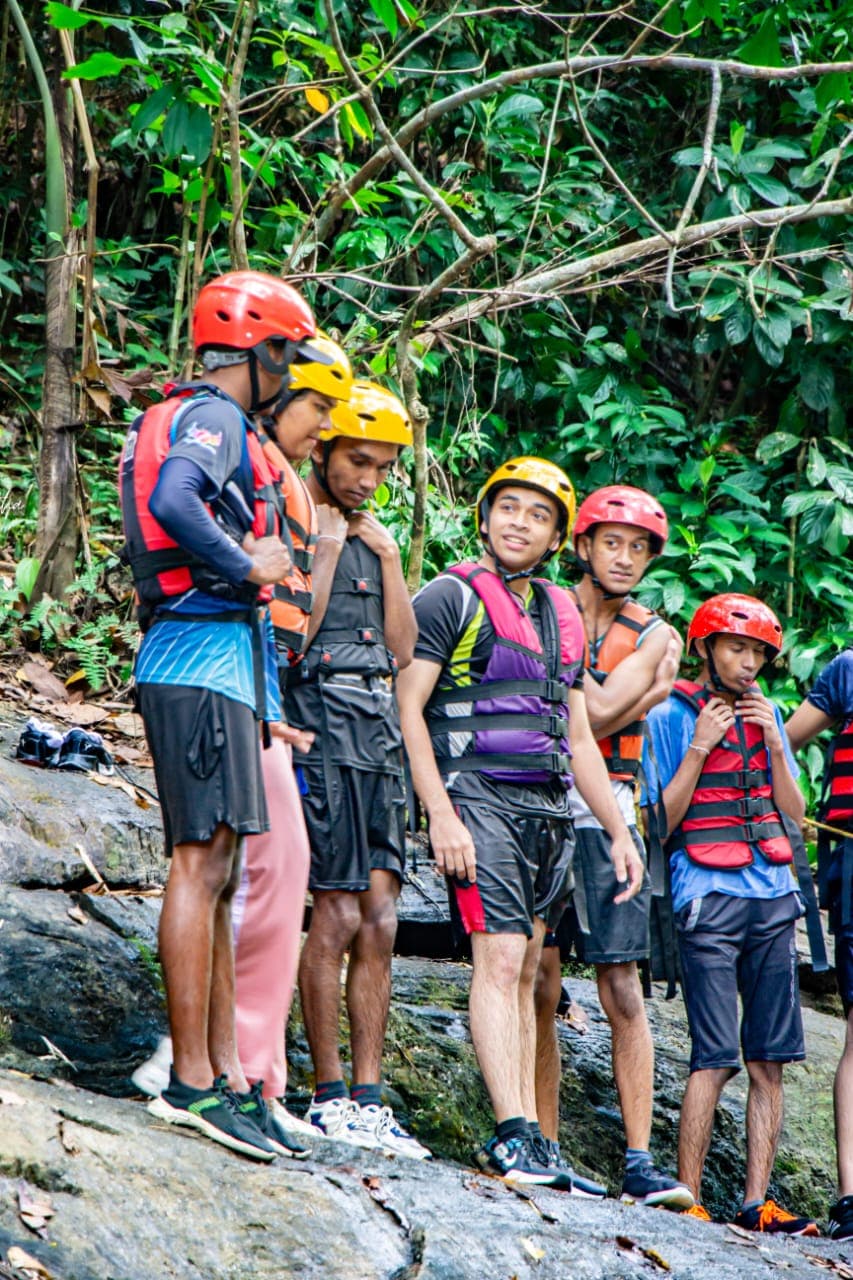
A count that happens once at the start of the day is not a supervision system. These are the fixed points where every pod gets counted, every time, regardless of group size.
- Off the bus, on arrival at base.
- After kit-up, once helmets and buoyancy aids are on.
- Immediately before water entry.
- On exit from the water.
- Before lunch.
- Before departure, boarding the bus home.
Counts are called out loud, at every transition, so your staff can hear them and check against their own list. Supervision is not something we ask you to take on trust.
Before the students hear anything
Staff are briefed first
Accompanying teachers are not briefed alongside their students. They are briefed first, on their own, before the student briefing begins. That briefing covers which pod goes where, who each guide is, where the exit points are on the route, where the fixed count points fall, and exactly what the stop procedure is.
This matters because your staff are not spectators for the day. They know the plan before the students do. If something needs raising quietly with a guide mid-activity, they already know who to speak to, and where that guide will be.
- Pod allocations and guide names, given to staff before the day starts.
- Exit points and fixed count points, shown on the ground, not just described.
- The stop procedure, explained to staff before it is explained to students.
The stop procedure
Any student can stop
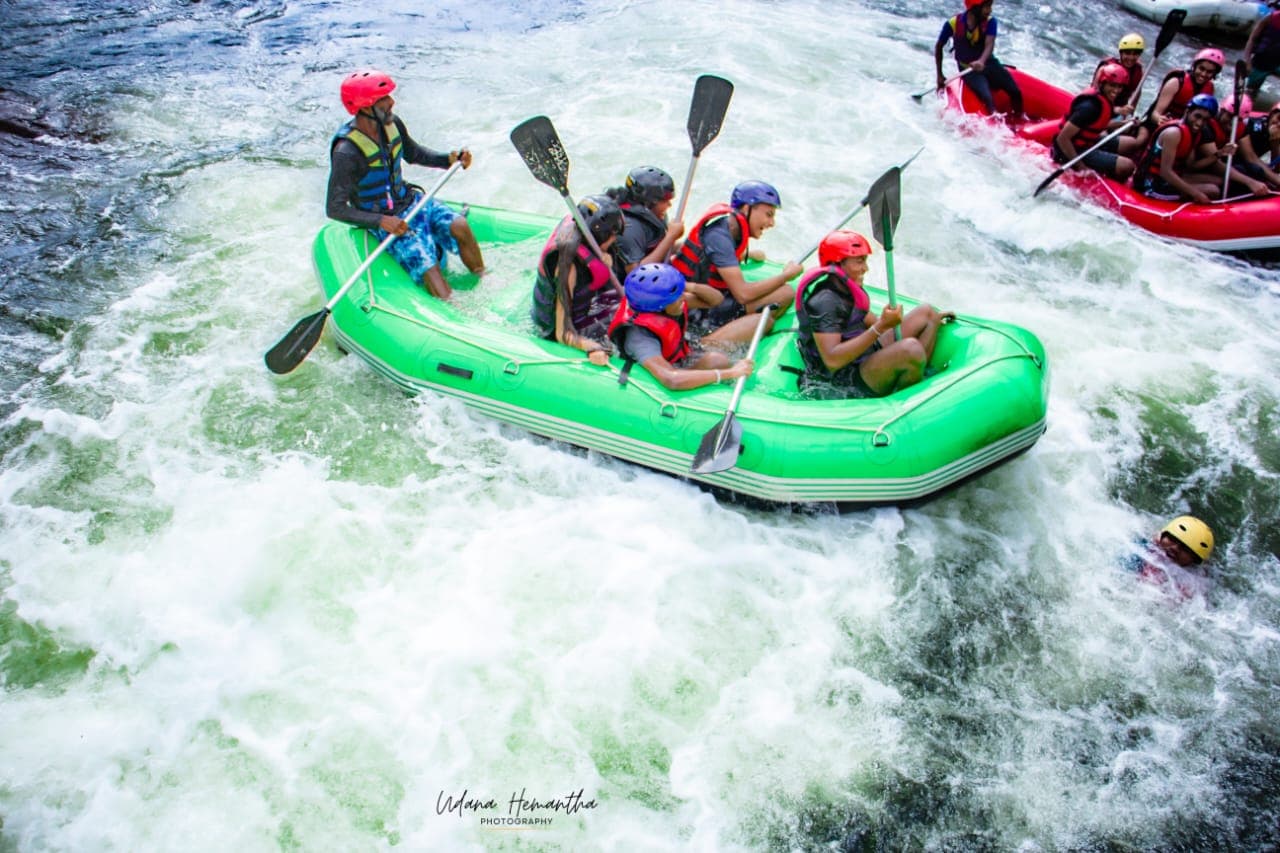
Every student is told, clearly, during the briefing, exactly how to signal they want to stop. A specific word. A specific gesture. Said to a specific person. It is not left as a vague "tell someone if you're not okay."
There is always an exit route off any activity. There is always somewhere comfortable to wait — shade, water, a member of staff or guide with them. Nobody is left alone at the side of a river. Nobody is talked into continuing once they have used the stop signal. There is no informal pressure from guides to push through it.
A student who is allowed to stop without an argument very often asks to rejoin twenty minutes later, once the fear or fatigue has passed. That only happens because stopping was never made into a bigger deal than it needed to be.
Ratios
Tell us your school's policy
Sri Lanka has no single statutory ratio for school excursions. Most schools work to their own internal policy, or to international guidance. That guidance typically points to around one adult per ten students for a day trip, and a tighter ratio for water.
We do not set that number for you. Our guides supervise the activity itself — the raft, the canyon route, the trek. Your staff supervise your students, as on any other school excursion. Tell us your school's ratio when you enquire. We size the student pods and the guide numbers around it, rather than assuming a figure that does not match your policy.
- No single Sri Lankan statutory ratio applies — most schools set their own.
- International guidance typically points to around 1:10 for a day trip, tighter on water.
- Guides supervise the activity; your staff supervise your students.
- Send us your ratio and we size pods and guide numbers to match it.
Medical and consent
What we need before the day
Late disclosure — a condition, a medication, an old injury nobody mentioned — is the most common cause of a genuinely bad day. None of this needs to go on a public form. It can come to us directly and confidentially.
- Any medical conditions relevant to physical activity, water, or heat.
- Medication a student needs to carry or take during the day.
- Allergies, separate from general dietary requirements.
- Recent injuries, surgery, or anything limiting physical activity.
- Each student's actual swimming confidence, not just a yes-or-no on ability.
- Anything else a guide should know before deciding how to run that student's day.
We are not asking out of caution for its own sake. A guide who knows about an asthma inhaler, or a recent wrist injury, before the activity starts can plan around it easily. A guide who finds out mid-river cannot.
Approval paperwork
Send us your school's checklist
Many Sri Lankan schools — government and national schools especially — submit a trip plan to an internal approval committee before a trip is authorised. That plan covers the route, the duration, the age group, the educational or co-curricular relevance, and the staff-to-student numbers.
We would rather answer that process directly than have you guess. Send us your school's external-provider checklist, whatever form it takes. We answer it line by line, in writing, before you commit to a date. Where the answer is straightforward, we say so. Where it is not — where something on your checklist is simply not something we can provide — we say that plainly too, rather than leaving it ambiguous until it matters.
For the approval file
What to send us
This is usually enough for us to answer most of an approval committee's questions in one reply.
- The activities and route you are proposing.
- The age group and any age range you need to plan around.
- The intended duration and departure/return times.
- The educational or co-curricular reason for the trip, if your school requires one.
- Staff and student numbers, including your intended supervision ratio.
- Any specific document types your approval committee asks for by name.
If something on your checklist is genuinely outside what we can provide, we tell you directly. We do not let it surface as a problem later.
What this page is not
We describe the day. No logos.
This is a description of our actual practice — briefings, numbered helmets, buoyancy aids, fixed guide-led pods, headcount discipline at every transition, and a stop procedure that is genuinely used, not just written down. It is not a list of badges, certification marks or registration numbers. We would rather tell you plainly what we do than decorate this page with claims we cannot fully stand behind.
If your school's approval process requires a specific type of documentation, ask us directly — by name, not as a general request. We answer honestly, including telling you clearly if it is something we cannot provide, before you put anything in front of your senior leadership team.
Explore the hub
More on school trips at Kitulgala
This page covers safety and supervision. These cover the programmes themselves.
Start here
School trips hub
The full overview of single-day school and student programmes at Kitulgala, for groups of up to 100.
Back to the hubThe core programme
Adventure day programmes
How a standard single-day school trip is structured, age band by age band.
See day programmesPrefects & senior students
Leadership camps
Day programmes built for prefect boards and senior leadership groups, where the activities expose how students lead under pressure.
Leadership programmesDofE & co-curricular
International Award expeditions
How our Kitulgala programmes fit alongside the Duke of Edinburgh's International Award adventurous journey and similar requirements.
Award and CAS days16+ groups
University & youth groups
Campus batch trips, freshers' days and youth organisation programmes for groups of sixteen and over.
Student group daysRead before you propose this
A few more pages worth checking
Our wider position
Safety
How we brief, equip and supervise every group at Kitulgala, across all group types.
Read our safety approachWho runs your day
Guide standards
How our guide team is trained, briefed and assigned to groups.
Read our guide standardsThe location
Kitulgala
The river, rainforest and canyon base every school day is built around.
About KitulgalaThe fine print
Booking terms
Confirmation, changes and cancellation, set out clearly for a school booking.
Read the termsAsk us directly
Contact
For any specific documentation or policy question this page has not answered.
Get in touch“The best as usual in organizing the whole trip and taking care of each detail. We all enjoyed it.”
Xclusive Adventures holds 4.8 on TripAdvisor and 4.9 on Google. Check us independently before you put a proposal in front of your principal — we would rather you did.
Send us your approval checklist
Tell us the year group, the headcount and the specific documentation your school needs before it signs off a trip. We come back within one working day with straight answers on ages, supervision and paperwork, before you commit to a date.
Ask about safety and supervisionQuestions & answers
School trip safety and supervision — your questions
What is the minimum age for white water rafting in Sri Lanka?
Sri Lanka Tourism Development Authority guidance sets a minimum age of 14 for white-water rafting, on all sections of the river. We hold to that as a firm rule — not a guideline we bend for a student who is nearly there, or for a signed parental consent form. Students under 14 are not excluded from the trip. They run a full day built from rainforest trekking, zip lining, supervised shallow water and team challenges instead.
Is Kitulgala rafting safe for school students?
The Kelani at Kitulgala runs grade 2-3 rapids, the standard introductory level used across Sri Lanka. Every student wears a helmet and buoyancy aid. Every raft is guided. The whole group is briefed together before anyone enters the water, and students move in fixed pods with headcounts called at every transition. We hold to the 14+ minimum age without exception. If conditions make the river unsuitable, we switch to the land programme instead of running it regardless.
Can non-swimmers go white water rafting at Kitulgala?
Yes, with planning rather than assumption. Every participant wears a buoyancy aid, and the safety briefing has a dedicated section on exactly what to do if you end up in the water. Tell us how many non-swimmers are in your group at the quoting stage, so we can plan pods and supervision around it. A genuinely good dry-land alternative exists for any student who would rather not enter the water at all. Nobody is talked into it.
How many chaperones do we need per student on a school trip in Sri Lanka?
There is no single statutory ratio for school excursions in Sri Lanka. Most schools work to their own internal policy, or to international guidance. That typically indicates around one adult per ten students for a day trip, and a tighter ratio for water-based activity. Our guides supervise the activities. Your teachers supervise your students. Tell us your school's own ratio when you enquire, and we size the student pods and guide team to match it.
What documents does a school need before booking an adventure trip in Sri Lanka?
It depends on your school, and often on whether it is a government, national or international school. Rather than guess, send us your school's own external-provider checklist. We answer it item by item, in writing, before you commit to a date. If something on it is genuinely outside what we can provide, we tell you plainly, rather than leaving that ambiguous until it matters.
What age can students go canyoning in Sri Lanka?
Canyoning does not have one published national age figure the way rafting does. The real limit is equipment specification and site conditions — the harness sizes we have, and the actual route your group will use. We confirm the age and size limits against your specific group in writing at the quoting stage, not on the day. Tell us the ages in your year group when you enquire, and we confirm what is workable before you plan around it.
Do you provide a risk assessment we can use for our school trip approval?
We answer, honestly and in writing, any specific question your school's approval process puts to us — how we run activities, supervise students, handle an emergency on the ground. Many schools use those written answers to build their own risk assessment. Send us your school's checklist. We go through it item by item, rather than offer a generic document that may not match what your committee actually needs.
What happens if a student wants to stop during an activity?
They stop. Nobody argues them out of it. Every student is told during the briefing exactly how to signal that they want to stop. There is always an exit route, and always somewhere comfortable to wait, with a guide or a member of staff. A student who is allowed to stop without a fuss often asks to rejoin a little later, once the moment has passed.
How do you keep track of students during the day?
Every student is assigned a numbered helmet at kit-up. It stays theirs for the day. Students move in fixed pods with one named guide throughout. Headcounts are called aloud at every transition — off the bus, after kit-up, before water entry, on exit, before lunch and before departure. Your own staff can hear the count and check it against their own list. Supervision is not something we ask you to take on trust.
What if a student's medical condition or allergy wasn't disclosed in advance?
Late disclosure is the most common cause of a student having a difficult day. That is exactly why we ask for conditions, medication, allergies, recent injuries and swimming confidence before the trip, not on the morning. If something is disclosed on the day itself, our guides adjust that student's activity plan on the spot. The better outcome is always for us to know in advance and plan around it properly.
Can a student who is about to turn 14 go rafting early?
No. We work to the SLTDA guidance of 14 years, on all sections of the river, as a firm minimum. We do not make exceptions for a student who is close to the age, or for a parent's written consent. A student who turns 14 before the trip date can join the river programme. A student who has not yet turned 14 on the day runs the age-appropriate land and water programme instead.
School group desk
Ask us anything on this page before you propose the trip
Tell us the year group, the headcount and any specific safety or documentation question your school needs answered. We reply within one working day with straight answers, in writing, before you commit to a date.
- A written quote. Clear per-person rate, inclusions listed.
- A draft running order, sized to your headcount.
- A named lead guide and a wet-weather plan, before you commit.
Prefer to talk it through first? Call +94714646865 or email info@xclusiveadventures.com.
More in this hub
School Trips
School Trips overview
School trips and student adventure days at Kitulgala, two hours from Colombo. Single-day, no overnight, age-banded programmes for groups of up to 100 students.
Adventure Day Programmes
The core single-day school adventure programme at Kitulgala: age-banded activities for ages 8 to 19, real rotations for large groups, and the full running order.
Leadership Camps
Prefect camps and student leadership days at Kitulgala. Rotating command on the river surfaces real leadership behaviour, with a usable debrief for staff afterwards.
International Award & CAS
How a Kitulgala adventure day supports the Duke of Edinburgh's International Award and CAS in Sri Lanka, and where your school's Award Leader stays in charge.
University & Youth Groups
Adventure days at Kitulgala for university batches, freshers' groups, sports clubs, scouts and alumni. Self-organising groups aged 16+ get full activity access.
Keep reading