
Adam’s Peak — Sri Pada in Sinhala — is Sri Lanka’s most sacred mountain, claimed by four of the world’s great religions as a site of divine significance. The summit holds a hollow in the rock revered as the footprint of the Buddha, the mark of Shiva, the first step of Adam, and the path of St. Thomas. Every year from December to May, thousands of pilgrims and travellers make the night climb up 5,500 steps to watch dawn break from the top and witness the mountain cast its perfect conical shadow across the clouds below — a spectacle that lasts only minutes and has been drawing people here for over a thousand years.
When to Go: The Pilgrimage Season
Adam’s Peak has a defined climbing season running from December to May, when the path is lit with strings of lights and tea stalls remain open through the night. Outside that window, from June to November, the path goes dark, stalls close, and the summit sits under monsoon cloud — the shadow won’t appear and the experience won’t deliver. The sweet spot within the season is January to April, when the weather is most reliable and the shadow most likely to perform. December can still be wet on the western slopes, and May is the quieter tail end of the season. If you want fewer crowds, go on a weekday; if you want the full pilgrimage atmosphere — chanting, bells, and collective purpose — choose a weekend or Poya full moon day.
The Climb: What to Expect
The standard route starts at Nallathanniya, also called the Hatton trailhead, and covers roughly 7km from the car park to the summit — almost entirely steps, around 5,500 of them. Allow three to five hours for the ascent depending on your fitness and the crowd density, and two to three hours for the descent, making it a genuine half-day commitment done in the dark on minimal sleep. The path is not technically difficult — there is no scrambling, no exposure, and no navigation — but it is relentless, and the final stretch steepens considerably. Rest points and tea stalls are spaced along the route and are worth using. At the summit there is a small Buddhist shrine, a bell pilgrims ring, and — if the sky is clear — a view across the entire hill country. The famous conical shadow appears at sunrise and lasts only minutes, so arrive early and do not cut it fine.
Getting There
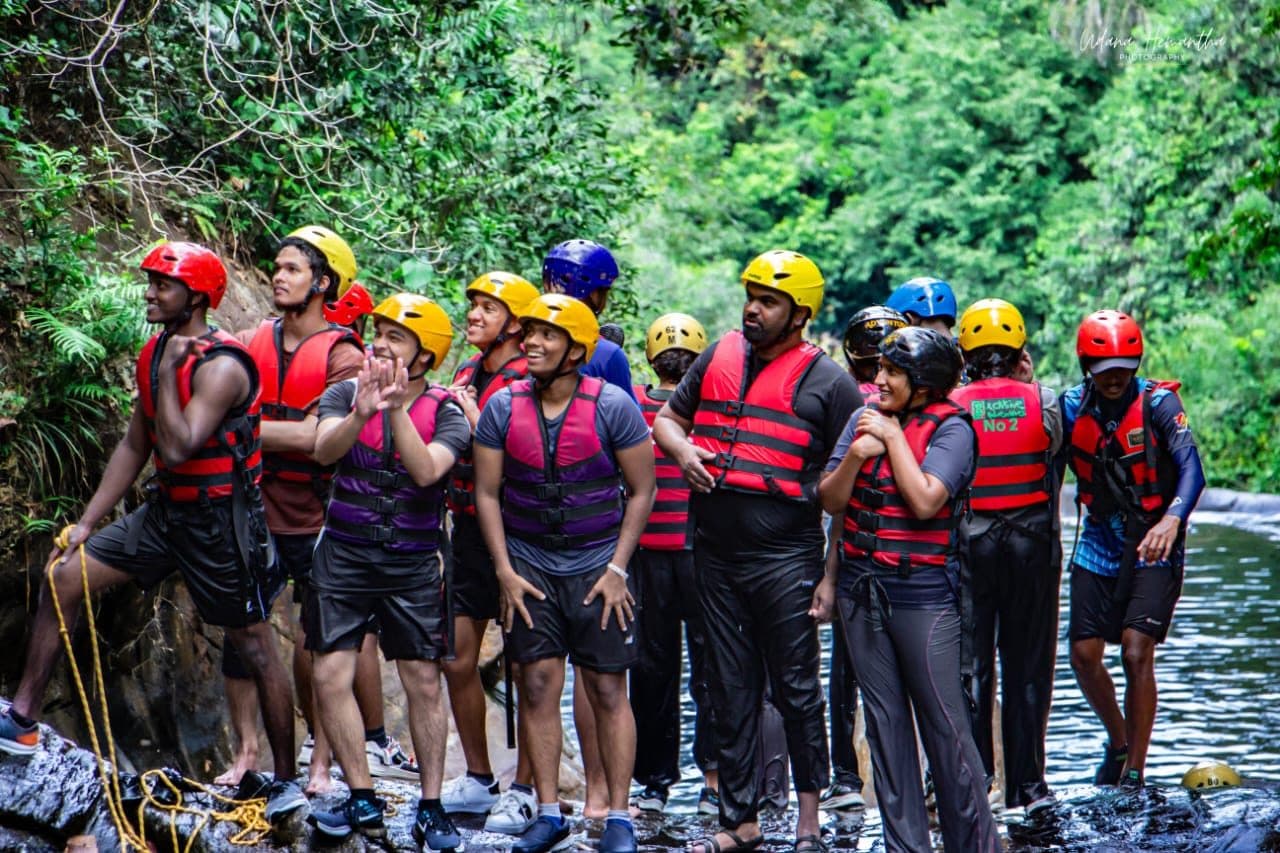
The easiest approach combines Kitulgala with the climb: Kitulgala sits roughly 1.5 to 2 hours from the Nallathanniya trailhead, so you can spend the day on the river or the waterfalls, drive up to Hatton in the early evening, rest at a guesthouse, and begin the climb around midnight. From Colombo, plan for a four to five hour drive or take the scenic hill-country train from Colombo Fort to Hatton, which takes a similar time and is genuinely beautiful; from Hatton, Nallathanniya is another 30 to 40 minutes by tuk-tuk or taxi. From Ella, the journey is around 2.5 to 3 hours via Nuwara Eliya, making it a good option if you are already in the hill country. Overnight accommodation in Nallathanniya or Hatton is available at all price points — you will want somewhere to rest before the climb and to recover afterwards.
What to Pack
The summit sits at 2,243 metres and even in the hottest months it can be 0 to 10 degrees Celsius at 3am with wind, so layers are not optional. Bring a warm base layer, a fleece, and a windproof outer shell, along with a headlamp, at least 1.5 to 2 litres of water, and snacks such as energy bars or bananas. Good walking shoes — trail runners or hiking shoes — are ideal; trainers work fine, but flip-flops are a serious mistake. A rain jacket is worth packing as summit weather can change quickly. Walking poles are optional but reduce real strain on the knees during the steep descent. Keep your pack light: you are carrying it for 5,500 steps.
Is This Right for You?
This is a genuine night hike on 5,500 steps after minimal sleep in cold wind, and it tests most people — that is information, not a deterrent. Fit adults and teenagers manage it well; if you hike regularly or exercise consistently, you are likely fine. Think more carefully if you have knee or joint problems, heart or lung conditions, or significant jet lag, and get medical advice before attempting it in those cases. Young children typically struggle with the cold, the dark, and the sheer step count. The famous shadow only appears when the sky below the summit is clear, so check the forecast and hold your expectations lightly — the climb itself is worth it regardless.
Fitting It Into Your Itinerary
Adam’s Peak works best mid-trip rather than at the start, so that jet lag has passed before you tackle a multi-hour night climb. Build in a recovery day after the descent and avoid scheduling a long transfer, a dive trip, or another active day for the morning you come down. The most effective sequence is adventure activities in Kitulgala, then an evening drive to Hatton for the midnight climb, then a slow morning descent and a rest day before continuing south or east. This flow is built into multi-day Sri Lanka itineraries that weave the climb into a broader hill-country arc.
Planning FAQs
How hard is the Adam’s Peak hike?
Moderately hard. There is no technical climbing involved — it is all steps — but 5,500 steps in the dark, on minimal sleep, in cold wind, tests most people. Fit adults and teenagers manage it well. Allow three to five hours up and do not rush the descent.
What time should I start climbing Adam’s Peak?
Leave the Nallathanniya trailhead between midnight and 2am to reach the summit before sunrise, which typically falls between 5:30 and 6am. Starting at midnight gives you buffer for a slower pace or rest stops. Starting after 1am is cutting it fine if you are not a fast hiker.
What is the Adam’s Peak shadow?
At sunrise the mountain casts a geometrically perfect conical shadow across the clouds below the summit. It lasts only a few minutes as the sun rises and only appears in clear conditions — cloud below the summit will block it. When it works, it is one of the most extraordinary natural phenomena in Sri Lanka.
Can I climb Adam’s Peak outside the pilgrimage season?
Technically yes, but it is not recommended. From June to November the path is unlit, all stalls are closed, the weather is wet and overcast, and the shadow will not appear. The experience is a fraction of what it is in season, with considerably more difficulty and risk.
Do I need a guide to climb Adam’s Peak?
Not for the main Nallathanniya route — the path is clearly marked and well-lit during the pilgrimage season. If you are combining the climb with a broader tour of the hill country, having a local guide or driver who knows the area and can manage logistics is a real advantage.
What should I eat before and during the climb?
Eat a proper meal before you start. Bring snacks for the climb such as energy bars, bananas, or nuts. Tea stalls along the route sell hot tea, roti, and simple foods during pilgrimage season and are worth stopping at — the hot tea at 2am on the mountainside is one of the small joys of the experience.
Is Adam’s Peak suitable for families with children?
Children who are fit and used to physical activity can manage it with realistic preparation and a slow pace. Young children find it genuinely tough — the cold, the dark, and the sheer number of steps make it extremely demanding for small kids.
How do I book the Adam’s Peak hike with Xclusive Adventures?
Visit our Adam’s Peak sunrise hike page for details, or contact us directly to discuss incorporating it into a custom itinerary. We handle the logistics — accommodation near the trailhead, transport, and timing — so you just have to climb.